Newsletter·

Shaping the future

Planetary Lab

About

The Planetary Lab is the research arm of Biosphere Economics. It explores the concepts, institutions and technologies required for humanity to navigate the Planetary Age and prepare the transition toward Homo biospheris, with particular attention to the relationships between economic systems, geopolitics, technological change and the biosphere.

The Planetary Lab's work includes publicly available research papers and policy notes, as well as private and confidential analyses for organizations.

The 2026-2027 Research Program

The Planetary Lab launched in spring 2026. It plans to publish up to 17 studies across four research fields in 2026 and 2027. The pace and scope of the program will depend on the funding secured to support it. They will be released here as they are completed and will remain freely available.

2026-2027 · 17 investigations · 4 research fields · 2 moonshots

Published studies

Available now, freely accessible.

Published studies

  • International Relations & World Order

    Published · August 2026 · 103 pages

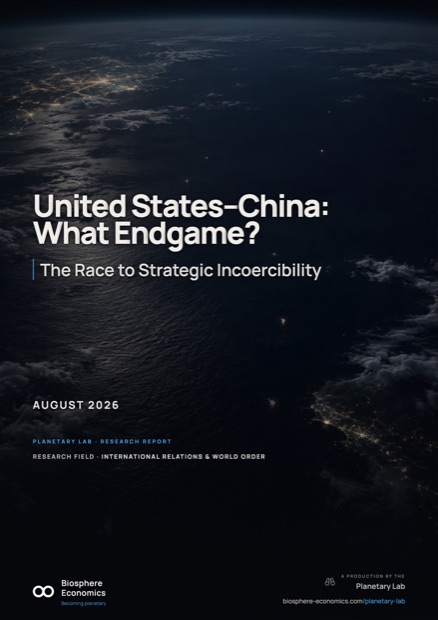
    United States-China: What Endgame?

    The Race to Strategic Incoercibility

    Examines what the United States and China are ultimately competing for, and what an endgame could actually look like. It argues that the decisive threshold may not be Chinese primacy, but the moment China becomes too powerful and resilient to be strategically coerced.

    Read the report
  • International Relations & World Order

    Published · August 2026 · 34 pages

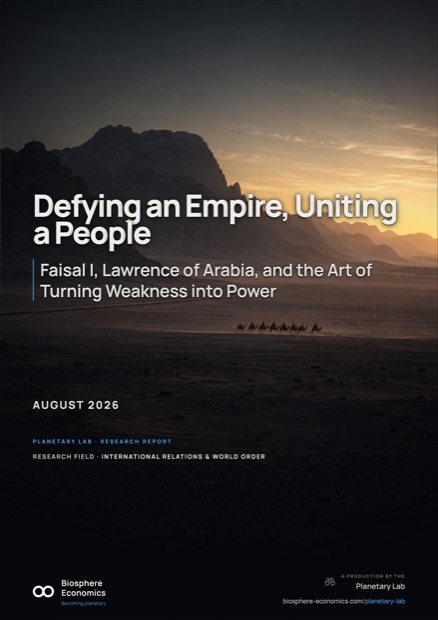
    Defying an Empire, Uniting a People

    Faisal I, Lawrence of Arabia, and the Art of Turning Weakness into Power

    Revisits the Arab Revolt through the partnership between Faisal I and T. E. Lawrence. It examines how mobility, sabotage, coalition politics and British resources allowed a weaker force to challenge an empire, and why victory in Damascus did not secure sovereignty afterward.

    Read the report
PublishedCompleted, publishing soonIn researchNot yet started

Upcoming studies

International Relations & World Order

Research program studies

  • Forthcoming·September 2026

    China's Nuclear Breakout

    The Arsenal Reshaping America's Nuclear Strategy

    Examines the transformation of the nuclear relationship as China rapidly expands its arsenal and the United States modernizes its own. It investigates whether a fundamentally new nuclear balance is emerging, and what it means for deterrence, escalation and strategic stability through 2035.

  • Forthcoming·October 2026

    How to Break a Superpower

    America, China, and the War Before the War

    Explores how great powers can weaken one another without direct war. Drawing on historical cases and contemporary US-China vulnerabilities, it examines the economic, technological, political, informational and societal instruments through which a rival can be induced to exhaust, divide or weaken itself.

  • In research

    The State of Europe

    Power, Vulnerability, and the Future of a Continent

    A comprehensive assessment of Europe's economic, industrial, technological, military, energy, demographic and political position, asking whether Europe still possesses the means to shape its own future.

  • Not yet started

    The Future of Europe

    Power, Sovereignty, and a Common Project

    Asks what would be required for Europe to remain prosperous, sovereign and politically consequential, and what common project could generate power, legitimacy and purpose.

  • Not yet started

    The State of France

    Strengths, Weaknesses, and the Risk of National Decline

    Tests narratives of French decline against the country's economic, industrial, technological, institutional, demographic and geopolitical position, distinguishing structural weaknesses from underused strengths.

  • Not yet started

    The Future of France

    Prosperity, Soft Power, and a Common Project

    Explores the structural choices that could restore economic dynamism, state capacity, sovereignty, social cohesion and a credible common project for France.

  • Forthcoming·September 2026

    Beyond the AI Oligopoly

    Decentralization and the Search for a Desirable AI Future

    Examines where power is concentrating across compute, models, data and inference, and whether decentralized architectures could support a more open, competitive and desirable AI ecosystem.

  • In research

    The AI of Homo biospheris

    Artificial Intelligence and the Emergence of Planetary Consciousness

    Explores whether AI could help humanity perceive itself as an interconnected planetary whole without becoming the substrate of collective intelligence, preserving human agency, diversity and autonomy.

  • Forthcoming·October 2026

    The AI of Homo biospheris: A Research Agenda

    The Scientific Foundations of Planetary Consciousness

    Defines the interdisciplinary research needed to test the possibility of planetary consciousness and AI's potential role in its emergence, connecting complexity science, collective intelligence, evolutionary biology, psychology, social systems and AI.

  • Not yet started

    Designing the AI of Homo biospheris

    From Research Program to Technical Architecture

    Translates the scientific agenda into design choices across data, models, agents, interfaces, governance and decentralized infrastructure, while asking how collective patterns can be made visible without creating a new center of power.

  • In research

    The Planetary Age

    Humanity at the Scale of the Earth

    Examines what changes when humanity becomes a force operating at planetary scale and when economic, technological and political choices become inseparable from the functioning of the Earth system.

  • Not yet started

    The Biosphere

    The Scientific Search for a Living Gaia

    Asks whether the question "Is the Earth alive?" can receive a scientifically meaningful answer, confronting Gaia theory with Earth-system science, geophysiology and complexity science and asking what evidence would be required.

  • Not yet started

    Homo biospheris

    The Emergence of a Planetary Humanity

    Explores whether humanity could undergo another major transition in social organization: billions of autonomous individuals becoming conscious participants in a planetary whole while remaining free, diverse and fully human.

  • Not yet started

    The Ten Missions of Homo biospheris

    A Program for Humanity in the Planetary Age

    Sets out ten transformations through which humanity could preserve and regenerate the Biosphere, master its technological power, advance human development and learn to act collectively at the scale of the problems it has created.

  • Not yet started

    The Biospheric Economy

    Rethinking the Economy from the Perspective of Life

    Reconsiders the economy as a subsystem of the Biosphere and asks how value, investment, production and prosperity could be reconciled with the regeneration of living systems and the expansion of human capabilities.

Private research

Research for organizations

Planetary Lab also conducts confidential research for companies, institutions and public bodies facing complex strategic questions.

Assignments range from focused strategic notes and executive briefs to deeper research projects, combining evidence, modelling and cross-disciplinary analysis.

Public program · Funding

Fund Planetary Lab public research

Planetary Lab publishes every study it completes, free of charge. To run the 2026-2027 program (up to seventeen research articles, four fields of study, two Moonshots), we are looking for a limited circle of organizations willing to fund it. Findings stay public; analysis stays independent.

Independence as protection for the value of the research. Funders can exchange upstream on questions and assumptions. Planetary Lab chooses its methods and publishes its conclusions freely: each study remains a reference that funders' teams, their clients and the public can use with confidence.

Two levels of support, with private exchanges around publications and the research program.

Root Partner

Support and follow

  • Early visibility on the 2026-2027 research program
  • Private discussions around major publications
  • One private conference each year
  • Conference may be held for internal teams, executives, boards or clients
  • Recognition as a Planetary Lab Root Partner

Canopy Partner

Support and shape

Everything included for Root Partners, plus:

  • Dialogue around emerging research questions
  • Upstream exchanges on selected research
  • Private discussions around findings and implications
  • Two private conferences each year
  • Direct exchanges around the research program
  • Recognition as a Planetary Lab Canopy Partner

Moonshot program

Two Moonshots

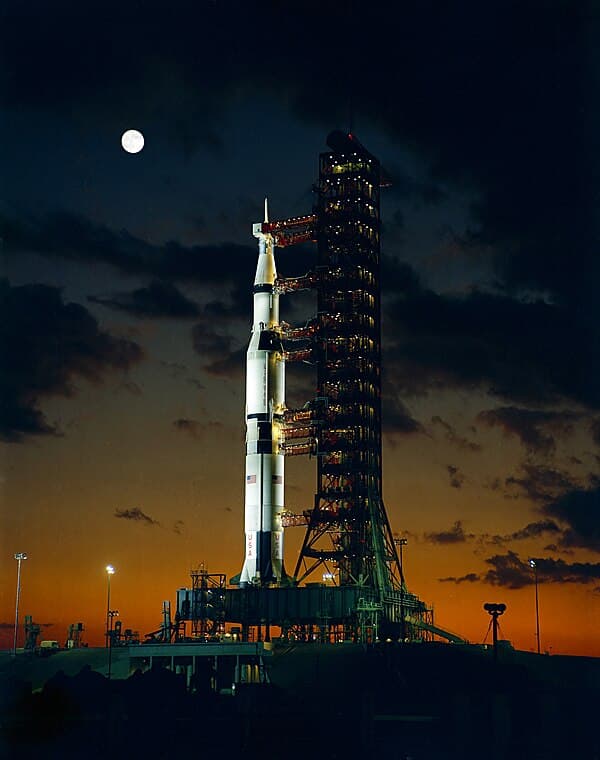
In 1962, J. F. Kennedy set what seemed an impossible goal: land a human on the Moon before the end of the decade and bring them back safely. In July 1969, it was done. A moonshot project is an ambition at the edge of the impossible, that redefines reality. The Planetary Lab has two.

  • The Biosphere

    Is the Biosphere alive?

    Can the Biosphere be understood scientifically as a living, self-regulating planetary system? This program brings together Gaia theory, geophysiology, Earth-system science, complexity science and biospheric sciences to investigate the question and determine what evidence would be required to answer it.

    Research program available in October

  • The AI of Homo biospheris

    Create the AI of Homo biospheris

    Can artificial intelligence help billions of autonomous human beings perceive the planetary whole they form, without replacing human agency or becoming the substrate of collective consciousness? The program explores an AI conceived as an intercessor: a temporary catalyst that reveals, connects and amplifies the signals of an emerging planetary humanity.

    Research program available in October

Saturn V, Apollo 4, NASA 1967

Saturn V · Apollo 4 · NASA, 1967 · Public domain