
Planetary Lab
Abstract
In 1916, the Arab Revolt faced an Ottoman Empire far stronger in manpower, weapons, and resources. The forces assembled by Sharif Hussein and his sons were divided among different tribes and leaders, with neither a national army nor an established state. Faisal commanded the revolt in the northern Hejaz, the western region of the Arabian Peninsula along the Red Sea that includes Mecca, Medina, Jeddah, and Taif. In the autumn of 1916, he met T. E. Lawrence, a young British intelligence officer whose years in archaeology and travel had given him an unusual knowledge of the region.
Arab forces gradually learned to avoid battles in which Ottoman superiority would be decisive. They relied on mobility, local intelligence, sabotage, and raids against lines of communication, above all the Hejaz Railway, forcing the Empire to protect hundreds of miles of track, stations, and garrisons. Lawrence contributed to this way of fighting and connected Faisal's forces to British weapons, gold, intelligence, and, later, vehicles and air power. At the same time, Faisal drew tribal contingents, autonomous chiefs, former Ottoman officers, Arab regular units, and Syrian nationalists into the same campaign. The capture of Aqaba in July 1917 opened the way toward Syria. In October 1918, Faisal entered Damascus at the head of a coalition capable both of military action and of claiming political authority.
Two questions run through this history: how can a weak force challenge an empire without becoming its military equal? How can deeply fragmented groups acquire the capacity to act together without surrendering their differences? Their success carried them to Damascus, but the means that had enabled them to challenge the Ottoman Empire were not enough to secure the sovereignty of the government Faisal sought to establish there.
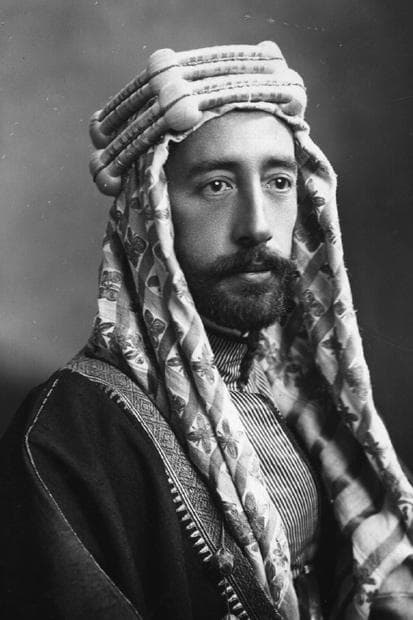
Faisal I
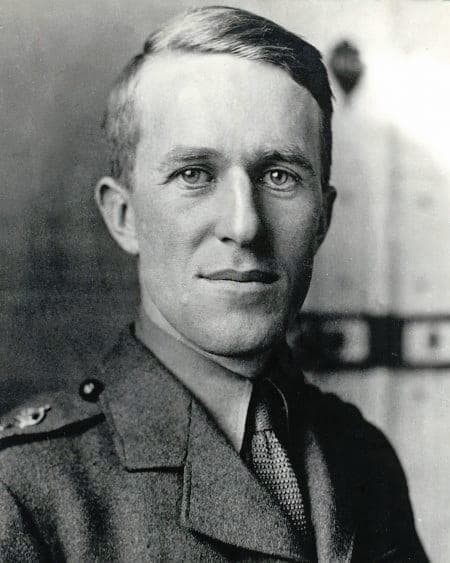
T. E. Lawrence
Three principal findings
Before they meet: what each man brings
By October 1916 Lawrence joins an existing command. Faisal possesses legitimacy and human networks the British cannot create for him; Lawrence helps secure access to intelligence, money, weapons, explosives, specialists, and communications with Cairo. Their alliance rests on this complementarity.
How the weak stop fighting by the strong's rules
After the failure before Medina, Arab forces attack the Hejaz Railway, preserve fighters, and take Aqaba in July 1917. The Empire retains vast material superiority but must devote a growing share of it to fixed positions and communications. Their weakness has not disappeared; its consequences have changed.
How Faisal holds a coalition together
Faisal negotiates with tribal chiefs, distributes money and weapons, recognizes local authority, and brings regular units and Syrian nationalists into the same campaign without dissolving their organizations. In Damascus in October 1918, this coalition attempts for the first time to become a government.
Between Medina and Damascus, Lawrence and Faisal had learned how to make Ottoman rule costly, dispersed, and vulnerable. At Maysalun in 1920, the means that had helped defeat the Ottomans were no longer enough. They had learned how to make an empire retreat on the battlefield. They lacked the power to impose on the victors the political order they wanted the war to bring into being.
Two mechanisms at the heart of the Revolt
- Defying an empire: mobility, raids on the Hejaz Railway, the landward capture of Aqaba, and British resources added to Arab knowledge of the terrain
- Uniting a people: Hashemite legitimacy, negotiation with tribal chiefs, regular units and Syrian networks held in the same campaign, and the move from coalition to government in Damascus
Much of the external support remained under British control. Once the Ottoman Empire disappeared, the divergence between British war aims and Hashemite ambitions became decisive.
When Faisal and Lawrence join forces in the autumn of 1916, the Ottoman Empire holds an overwhelming advantage in manpower, weapons, and organization. Faisal already commands a force, possesses Hashemite legitimacy, and knows how to negotiate among groups whose interests do not always coincide. Lawrence knows the region, serves in British intelligence, and can connect Faisal's army to Allied material resources. Their alliance enables the Arab forces to exploit mobility, knowledge of the terrain, and the vulnerabilities of Ottoman communications while drawing on British military resources they cannot produce themselves. It plays an important part in the campaign that ends in victory in 1918. After the war, however, it is no longer enough for Faisal to secure recognition for, and defend, the political order he seeks to establish.
Documents
Read the paper
Sources
Selected references
- Ali A. Allawi, Faisal I of Iraq, Yale University Press, 2014.
- Jeremy Wilson, Lawrence of Arabia: The Authorised Biography, Heinemann, 1989.
- T. E. Lawrence, Seven Pillars of Wisdom.
- T. E. Lawrence, "The Evolution of a Revolt," Army Quarterly, vol. 1, 1920, pp. 55–69.
- Eugene Rogan, The Fall of the Ottomans, Basic Books, 2015.
- Sykes–Picot Agreement, May 1916.
- Faisal–Weizmann Agreement, 3 January 1919.
- King–Crane Commission Report, 1919.