
Becoming Planetary · Bonus 1
Back to the Moon
Fifty-four years after Apollo, humanity departed again in a new struggle for planetary dominance.
The mission · April 2026
Artemis 2 - The United States in the lead, for now
In April 2026, for the first time since Apollo 17 in 1972, four human beings approached the Moon. Artemis 2 was a lunar flyby, a demonstration that humanity still knows how to go that far. Behind the mission lies a race between two powers, the United States and China, over resources, and the species' ancient fascination with the satellite that regulates our tides and has guided our calendars since prehistory.
USA vs China · Two programmes, one objective
The Moon, once again a planetary power stake
Two nations are targeting the lunar south pole, where ice water reserves can serve as fuel and drinking water. The United States relies on an international coalition (NASA, ESA, JAXA, CSA), but its schedule has slipped: the crewed landing, originally planned for Artemis 3, has been pushed back to Artemis 4, no earlier than early 2028. China, building its programme alone, officially targets 2030, but its robotic milestones are on track and its chief designer has called that date intentionally conservative. The race is open.
États-Unis
NASA · Artemis
Artemis 1: uncrewed lunar orbit flight.
Artemis 2: first crewed lunar flyby since Apollo 17.
Artemis 3: low Earth orbit mission, rendezvous with Blue Origin and SpaceX HLS landers. No lunar landing.
Artemis 4: first crewed lunar landing since 1972, first woman on the Moon.
Artemis 5: start of construction of the permanent base at the south pole. The Gateway project is cancelled.
Chine
CNSA · Chang'e
Chang'e 5: lunar sample return, first in 44 years.
Chang'e 6: first sample return from the far side of the Moon.
Chang'e 7: south pole exploration, search for water ice.
Uncrewed Mengzhou-Lanyue mission: test of the lunar lander before the crewed attempt.
Chang'e 8: in-situ resource tests at the south pole.
Official goal: first Chinese crewed lunar landing.

Moon south pole · Kaguya probe · November 7, 2007 · JAXA / NHK
Anticipatory fiction · 2010 · 2012
Two novels written before the race began
Fourteen years before Artemis 2, Jean-Pierre Goux published Blue Century (2010, republished in 2018 and 2021), then Shadows and Light (2012, republished in 2018 and 2022): two novels imagining a race to the Moon between the United States and China for helium-3, with an American crew whose mission goes wrong. One survivor, Paul Gardner, returns transformed, and his testimony triggers the awakening that becomes the Blue Revolution, Homo biospheris and the Overview Effect extended to all of humanity.

Blue Century · Vol. 1
Gaia's Dream
2010 / 2018 / 2021

Blue Century · Vol. 2
Shadows and Light
2012 / 2018 / 2022
Paul Gardner · central character
In the novels, the American crew numbers four people including a woman and an African American, a composition NASA would replicate exactly with Artemis 2 fifteen years later, with one exception: no Canadian in the novel. In Blue Century, a diplomatic incident occurs between China and the United States. Paul Gardner, the sole survivor, has only one occupation while waiting for rescue: watching Earth. He triggers the awakening that gives birth to the Blue Revolution, Homo biospheris, and OneHome.
Crew composition
Three "firsts" for a single crew

Reid Wiseman, Victor Glover, Christina Koch, Jeremy Hansen. NASA / CSA.
The Overview Effect · On The Late Show with Stephen Colbert
Crewed flyby · April 2026
The first crew to have approached the Moon since Apollo 17 in 1972
Artemis 2 was a lunar flyby, not a landing. The Orion capsule passed within 9,200 km of the lunar surface and used the Moon's gravity to send the crew back toward Earth. The mission lasted ten days and took four astronauts further from Earth than any human being since the Apollo missions.


Left to right: LC-39B on February 1, 2026 (NASA/Ben Smegelsky) · Sunrise on January 28, 2026 (NASA/Cory S. Huston) · Launch on April 1, 2026 at 6:35 PM EDT (NASA/Bill Ingalls)
SLS Block 1 vs Saturn V · Comparison
Saturn V did everything: it landed men on the Moon by itself. SLS operates in a distributed architecture where the lunar lander arrives separately (Starship HLS, Blue Moon). SLS produces more thrust at liftoff (39.1 MN vs 34 MN), but Saturn V carried more toward the Moon thanks to a much larger third stage.
Height
SLS
98 m
Saturn V
110 m
LEO payload
SLS
~95 t
Saturn V
~130 t
Trajectory · Schematic diagram
Blue Marble 1972 · Hello World 2026
Gaia did not get sick
Many compared the two photos and concluded that the Earth had gotten sick in 54 years. That is the wrong reading. The 2026 photo was taken at night, with a special sensor, just after the trans-lunar injection burn. At the time of departure, the Moon was full: Earth was in the shadow cone, on its night side. The astronauts could barely see Earth from Orion, exactly as described in Jean-Pierre Goux's novel.

Blue Marble
December 7, 1972 · Apollo 17 · NASA

Hello World
April 2, 2026 · Artemis 2 · NASA
Apollo 8 to Artemis 2 · All crewed missions
The Moon and Earth at each departure
At each crewed lunar mission, the Moon and Earth displayed a different phase. Artemis 2 is the mission with the fullest Moon and the least visible Earth in the entire history of crewed lunar exploration.
Moon and Earth phases at launch
Every crewed lunar mission, from Apollo 8 to Artemis 2
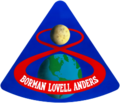
Apollo 8
1968
52%48%
Apollo 10
1969
73%27%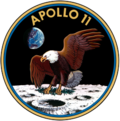
Apollo 11
1969
0%100%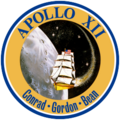
Apollo 12
1969
8%92%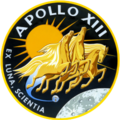
Apollo 13
1970
77%23%
Apollo 14
1971
22%78%
Apollo 15
1971
16%84%
Apollo 16
1972
2%98%
Apollo 17
1972
17%83%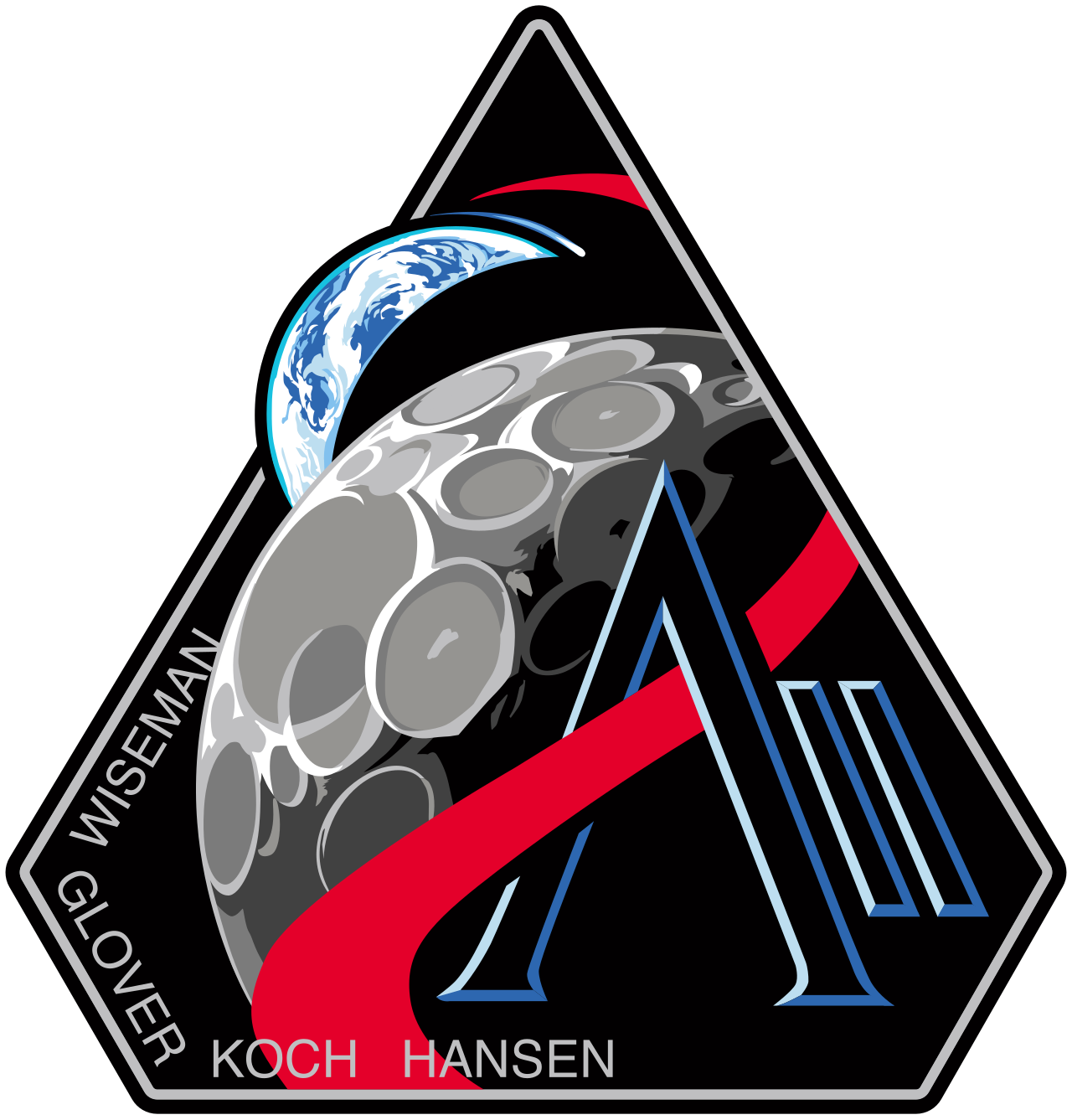
Artemis 2
2026
85%15%Full moon at departure · Earth in darkness
No other Apollo or Artemis mission departed with a Moon as full as this one. The fuller the Moon, the darker Earth's night side, and the less visible it is from a spacecraft heading toward the Moon. Artemis 2 therefore left an Earth nearly invisible from space: that is precisely the astronomical detail Jean-Pierre Goux had chosen for his novel years before the mission.


April 5, 2026 · Orion approaching the Moon · NASA
April 6, 2026 · Lunar flyby
The far side, the eclipse
A New View of the Moon
April 6, 2026 · 5:41 PM CDT · Far side flyby · NASA
Earth sets over the Moon's curved limb during the far-side flyby. Orientale Basin sits on the edge of the visible surface, and Hertzsprung appears as two subtle concentric rings. Earth's dark portion is experiencing nighttime.

Artemis II in Eclipse
April 6, 2026 · 54 minutes of totality · NASA
The Moon eclipses the Sun for 54 minutes from Orion's vantage point, far beyond what is possible from Earth. A glowing halo surrounds the dark lunar disk (solar corona or zodiacal light, still under investigation), and stars normally too faint to see near the Moon become visible.
Synthesis
From rivalry to planetary consciousness?
Reading 1
The power rivalry
A race replicating Cold War dynamics, with a risk of military escalation in a domain without prohibitive treaties.
Reading 2
Planetary consciousness
The beginning of an era where humanity perceives itself from the outside. What Jean-Pierre Goux described in Blue Century: a shock of consciousness that crosses all borders, "for all mankind".
Both readings are true at once. The Artemis 2 astronauts said so themselves: seeing Earth from the Moon changes something. The question is which one will prevail.
Crew testimony
Into action
The Apollo astronauts saw Earth from the Moon and returned transformed. Artemis 2 reopens that window, sixty years later. These two formats bring that same shift in perspective to your organization.
Keynote conference
The Earth from Space
A vision to change our relationship with the world. For audiences of any size.
30 to 90 min · executive committees, corporate events
See all conferencesStrategic seminar
Navigating the Planetary Age
Toward the planetary-robust enterprise. A seminar that builds on this diagnosis to equip your organization.
1 to 2 days · executive teams, leadership committees
See all seminars