
Planetary Lab
Abstract
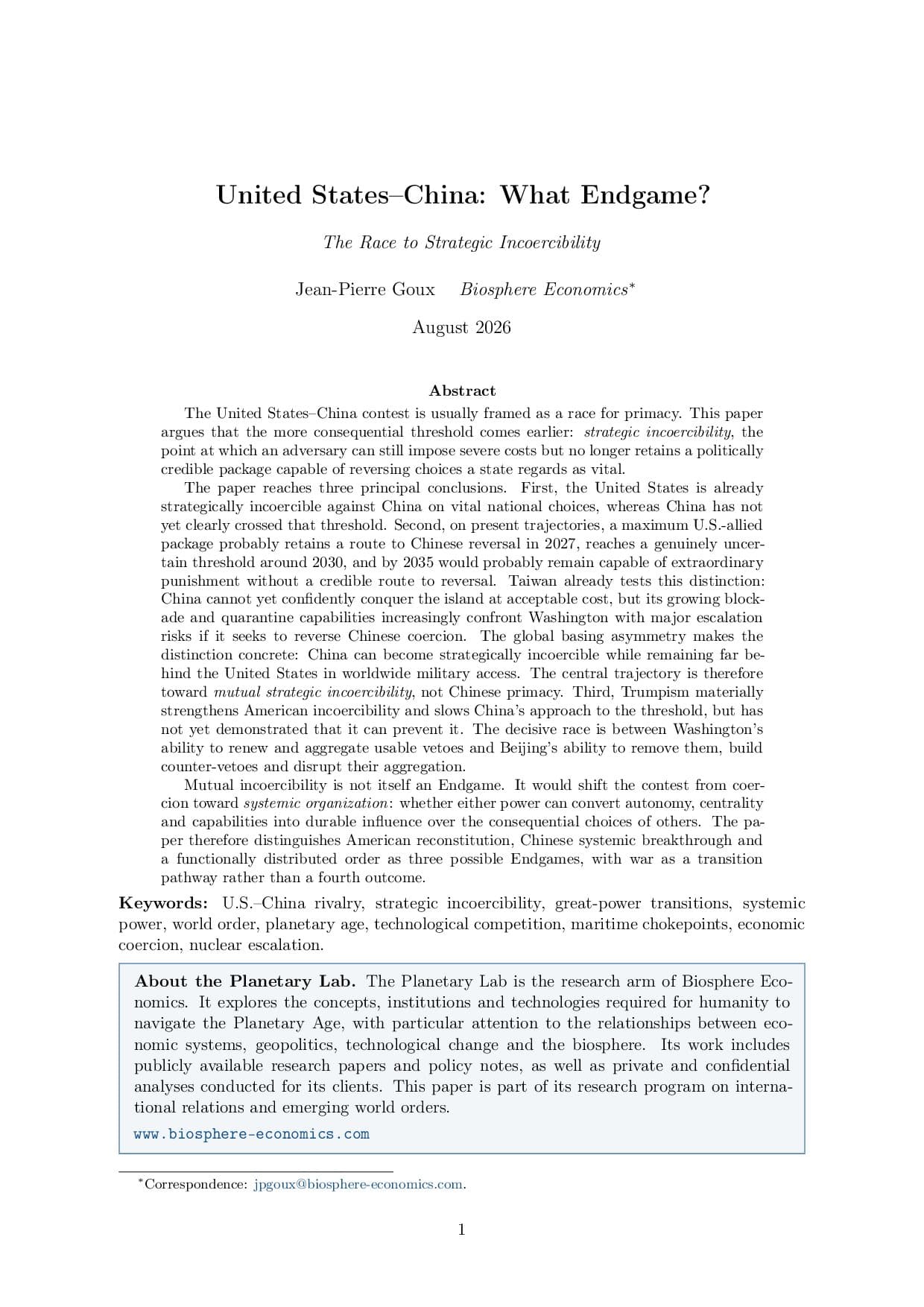
The United States–China contest is usually framed as a race for primacy. This paper argues that the more consequential threshold comes earlier: strategic incoercibility, the point at which an adversary can still impose severe costs but no longer retains a politically credible package capable of reversing choices a state regards as vital.
Three principal conclusions
U.S. incoercibility on vital choices
The United States is already strategically incoercible against China on vital national choices, whereas China has not yet clearly crossed that threshold.
The 2027–2035 window
On present trajectories, a maximum U.S.-allied package probably retains a route to Chinese reversal in 2027, reaches a genuinely uncertain threshold around 2030, and by 2035 would probably remain capable of extraordinary punishment without a credible route to reversal. Taiwan already tests this distinction: China cannot yet confidently conquer the island at acceptable cost, but its growing blockade and quarantine capabilities increasingly confront Washington with major escalation risks if it seeks to reverse Chinese coercion. The global basing asymmetry makes the distinction concrete: China can become strategically incoercible while remaining far behind the United States in worldwide military access. The central trajectory is therefore toward mutual strategic incoercibility, not Chinese primacy.
Trumpism and the decisive race
Trumpism materially strengthens American incoercibility and slows China's approach to the threshold, but has not yet demonstrated that it can prevent it. The decisive race is between Washington's ability to renew and aggregate usable vetoes and Beijing's ability to remove them, build counter-vetoes and disrupt their aggregation.
Mutual incoercibility is not itself an Endgame. It would shift the contest from coercion toward systemic organization: whether either power can convert autonomy, centrality and capabilities into durable influence over the consequential choices of others.
Three possible endgames
- American reconstitution
- Chinese systemic breakthrough
- Functionally distributed order
War is not a fourth endgame; it is one of the transition pathways that may lead there.
China does not need to surpass the United States in aggregate power to transform the strategic relationship. The earlier threshold is strategic incoercibility: the point at which an American-led coalition can still impose severe costs on China but can no longer plausibly compel Beijing to reverse a decision it regards as vital. The strategic race is therefore two-sided. Beijing is trying to remove the dependencies that still give Washington leverage over vital Chinese choices. Washington, meanwhile, must create new sources of leverage as old ones erode, and it can do so only if allied capabilities can be turned into coordinated action quickly enough.
Documents
Read the paper
Sources
Selected references
- Henry Farrell & Abraham L. Newman, "Weaponized Interdependence," International Security, 2019.
- U.S. Energy Information Administration, World Oil Transit Chokepoints, 2026.
- International Monetary Fund, People's Republic of China: 2025 Article IV Consultation, 2026.
- Federal Reserve Board, The International Role of the U.S. Dollar – 2025 Edition, July 2025.
- Congressional Budget Office, The Budget and Economic Outlook: 2026 to 2036, February 2026.
- Elbridge A. Colby, The Strategy of Denial, Yale University Press, 2021.
- CSIS, Troubled Straits: Analyzing Trade Chokepoints in the South China Sea, 2026.
- Hans M. Kristensen et al., Chinese nuclear weapons, 2025, Bulletin of the Atomic Scientists.