Manifesto · Becoming Planetary
The Planetary Age
The tipping point with two outcomes
The age we inhabit and shape
The age of total interdependence
For the first time, the decisions of one species reverberate across the entire planetary system: ecosystems, supply chains, markets, geopolitical balances. A blocked strait raises prices on the other side of the world. A degraded soil reshapes the food security of entire continents. An artist from a garage can reach billions of people. The interdependence is now total, and it runs in both directions: from the world toward us, and from us toward the world.
The planetary age
First species at the scale of the Earth
For the first time in 4.6 billion years, a single species has become a geophysical force at the scale of the Earth. Its infrastructure covers every continent. Everything it depends on to survive rests on a single living organism: the Biosphere.
Planetary boundaries · 2025
In 2009, Johan Rockström and an international team identified 9 biophysical processes that regulate the stability of the Earth system. Staying within these limits ensures a safe operating space for human civilizations. In 2025, 7 of 9 are breached.
Planetary Health Check 2025 · Stockholm Resilience Centre / Potsdam Institute
Doomsday Clock
Created in 1947 by Manhattan Project scientists to assess nuclear risk, the Clock has since 2007 incorporated climate risks, and since 2017 disruptive technologies, artificial intelligence and biological risks. It measures the global distance to a civilizational catastrophe. Midnight represents the collapse of civilization. It is updated annually by the Bulletin of the Atomic Scientists.
Distance to midnight since 1947 · hover to see year and time
In 2026, the Bulletin of the Atomic Scientists advanced the hand from 89 to 85 seconds to midnight: the closest level to midnight ever reached since the clock was created.
"We are now, for the first time, feeling the effects in a critical way of the actual, finite size of the Earth."
John von Neumann · "Can We Survive Technology?", 1955
Within twelve months, three distinct events converged on the same reality: Earth is finite, its limits are modelable, and it now had a face. Humanity did not alter its trajectory.
The Limits to Growth
The Club of Rome commissioned Donella and Dennis Meadows, with Jørgen Randers and William Behrens at MIT, to produce the first computer model simulating interactions between world population, natural resources, industrial output, and pollution. In eleven of the twelve scenarios explored, maintaining current trends led to systemic collapse before 2100.
"To achieve this change would mean that the globe's people establish their status, derive satisfaction, and challenge themselves with goals other than ever-increasing production and ever-accumulating."

1st ed., 1972
Earth Summit, Stockholm
United Nations Conference on the Human Environment
The conference brought together 113 states and more than 400 non-governmental organisations around a shared finding: environmental damage does not respect national borders. Its slogan, 'Only One Earth', put into words what the Blue Marble photograph would make visible six months later. The summit founded the United Nations Environment Programme, created World Environment Day on 5 June, and adopted a Declaration of 26 principles. The tension between industrialised nations focused on conservation and developing countries asserting their right to growth ran through every negotiation. It was not resolved. It still structures the climate debate fifty years later.

Only One Earth
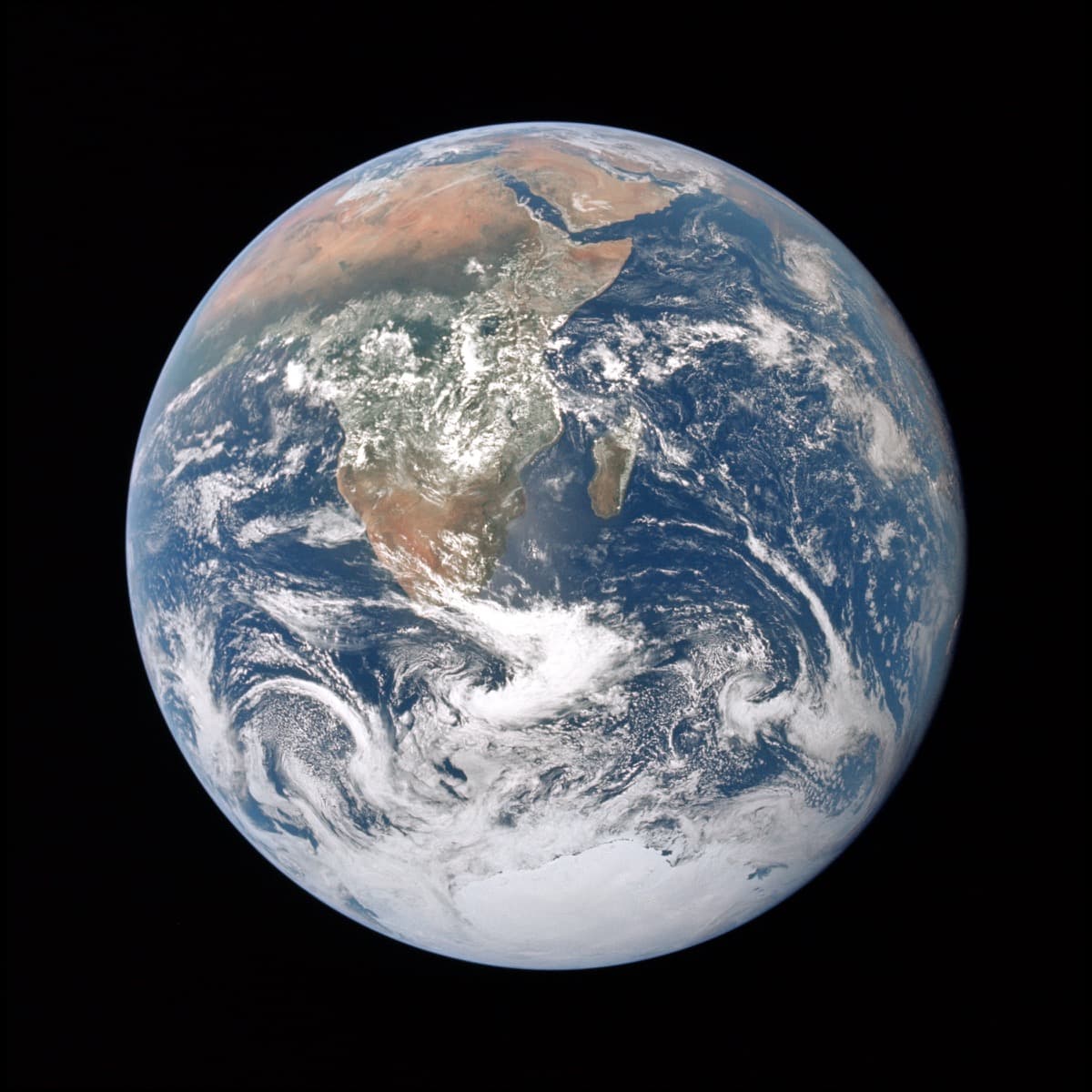
Blue Marble
At 45,000 km from Earth, the Apollo 17 crew photographed the entire illuminated planet. For the first time in human history, and in the history of Earth itself, the full face of the planet was revealed. This image became a lifeline for the environmental movement, at the precise moment when problems were ceasing to be local and becoming global, demanding cooperation between states. It made possible what statistics cannot: giving Earth a face that could be loved and protected. It is the most reproduced image in human history.

These three events were pointing to the same reality. Humanity could have begun entering the planetary age in 1972. It chose a different trajectory. What if that trajectory, which looks suicidal from where we stand today, was in fact concealing the conditions necessary for Homo biospheris to emerge?
These four trends reinforce one another. Each one amplifies the reach of the other three and narrows the room for isolated responses.
Total interdependence
At this scale, almost no action is truly isolated. The 2020 pandemic was the most immediate demonstration: within weeks, the global economy stopped not by decision, but by coupling.
Finite world, no outside
Natural frontiers long served as dumping grounds for the contradictions of growth models. Today the world has almost no outside left. Seven of nine planetary boundaries have been crossed, the last two are under pressure.
Shocks faster than institutions
The propagation speed of systemic shocks exceeds that of institutional responses. Decision: minutes. Response: years. The gap widens as the density of couplings increases.
Existential competition
Several actors now operate at planetary scale within no shared governance framework. None has the Biosphere as its horizon. No prior civilization inhabited a world where every major system, from climate to finance, was so deeply coupled.
Tipping point
Only two possible outcomes
The choice is no longer merely political or economic. A civilisation acting at the scale of the Earth must learn to govern itself at that scale, or face the consequences of its own power.
Growing turbulences
Cascading crises · Collapse of collective absorption capacity · Coupled systems without a guiding narrative
Planetary dimension assumed
Humanity recognizes its power and orients it · Shared project at the scale of the Biosphere · Entry into the age of Homo biospheris
Before any response to the planetary age can be formulated, two frame shifts are required. They condition the very readability of the problem.
Outward
The industrial age treated the Earth as a stage: nature as backdrop, humanity at the center. The required shift is to see the Earth as an organism of which humanity is a provisional and recent organ. The living world was planetary three billion years before Homo sapiens.
Forward in time
Political decisions are measured in electoral cycles, corporate decisions in quarters. Biospheric processes operate in decades, centuries, millennia. The planetary age demands aligning these timescales.
Synthesis
The crisis is not only material
The planetary age cannot be navigated from within the frameworks that produced it. The categories inherited from the industrial age, designed for a world of separate nations and supposedly unlimited resources, can no longer describe humanity's actual condition. The crisis is not only material: it is a crisis of intelligibility. It demands concepts, narratives and frameworks yet to be invented.
A production of the Planetary Lab
© 2026 Biosphere Economics · CC BY-NC-ND 4.0
Into action
Seven of nine planetary boundaries are crossed. Most strategic frameworks were designed for a world that no longer exists. These two formats help your organization navigate the one we live in now.
Keynote conference
The Planetary Age
Understand the great systemic transition of our era. For your leaders, in a single narrative arc.
30 to 90 min · executive committees, corporate events
See all conferencesStrategic seminar
Navigating the Planetary Age
Toward the planetary-robust enterprise. A seminar that builds on this diagnosis to equip your organization.
1 to 2 days · executive teams, leadership committees
See all seminars