
Planetary Lab
Abstract
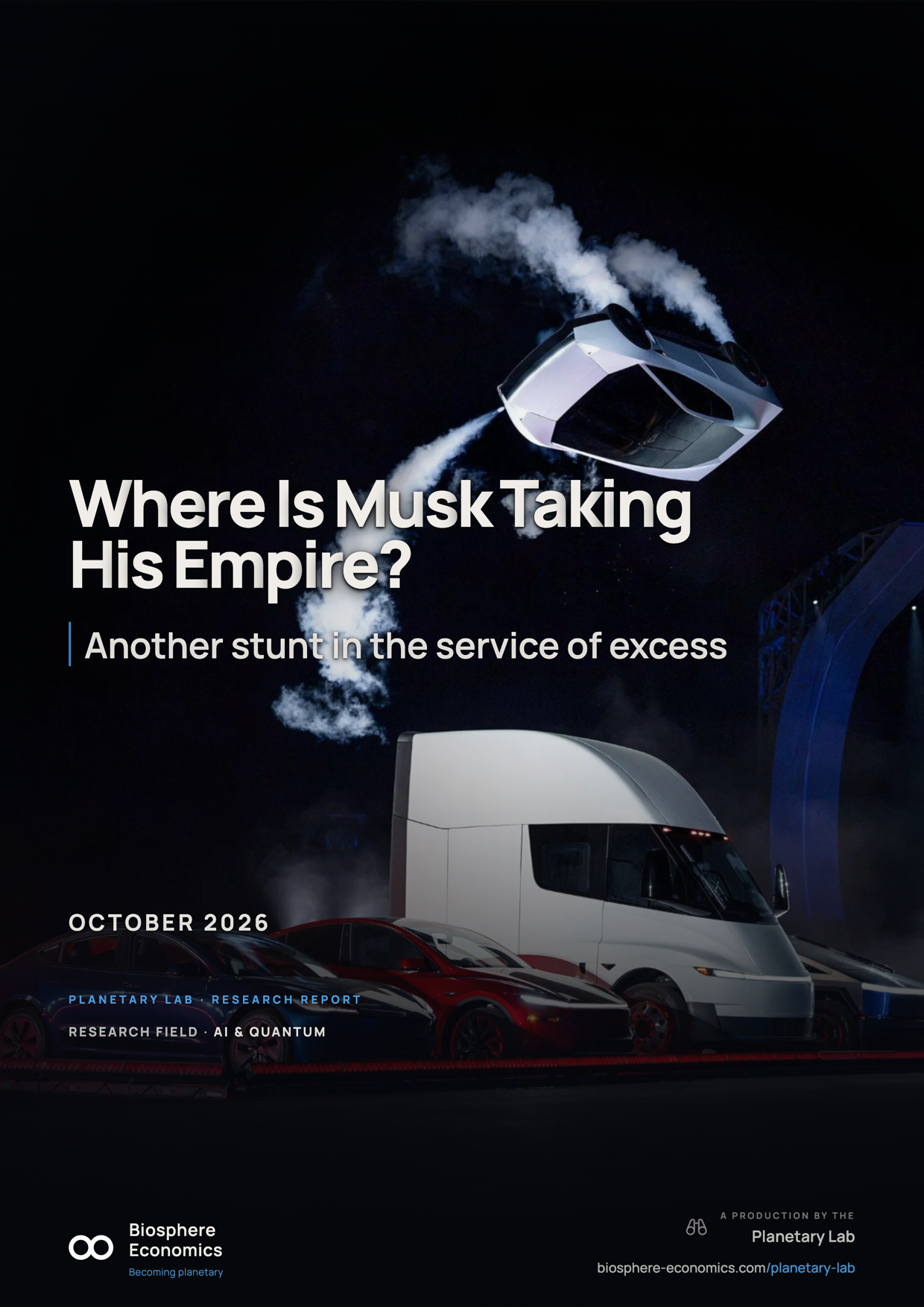
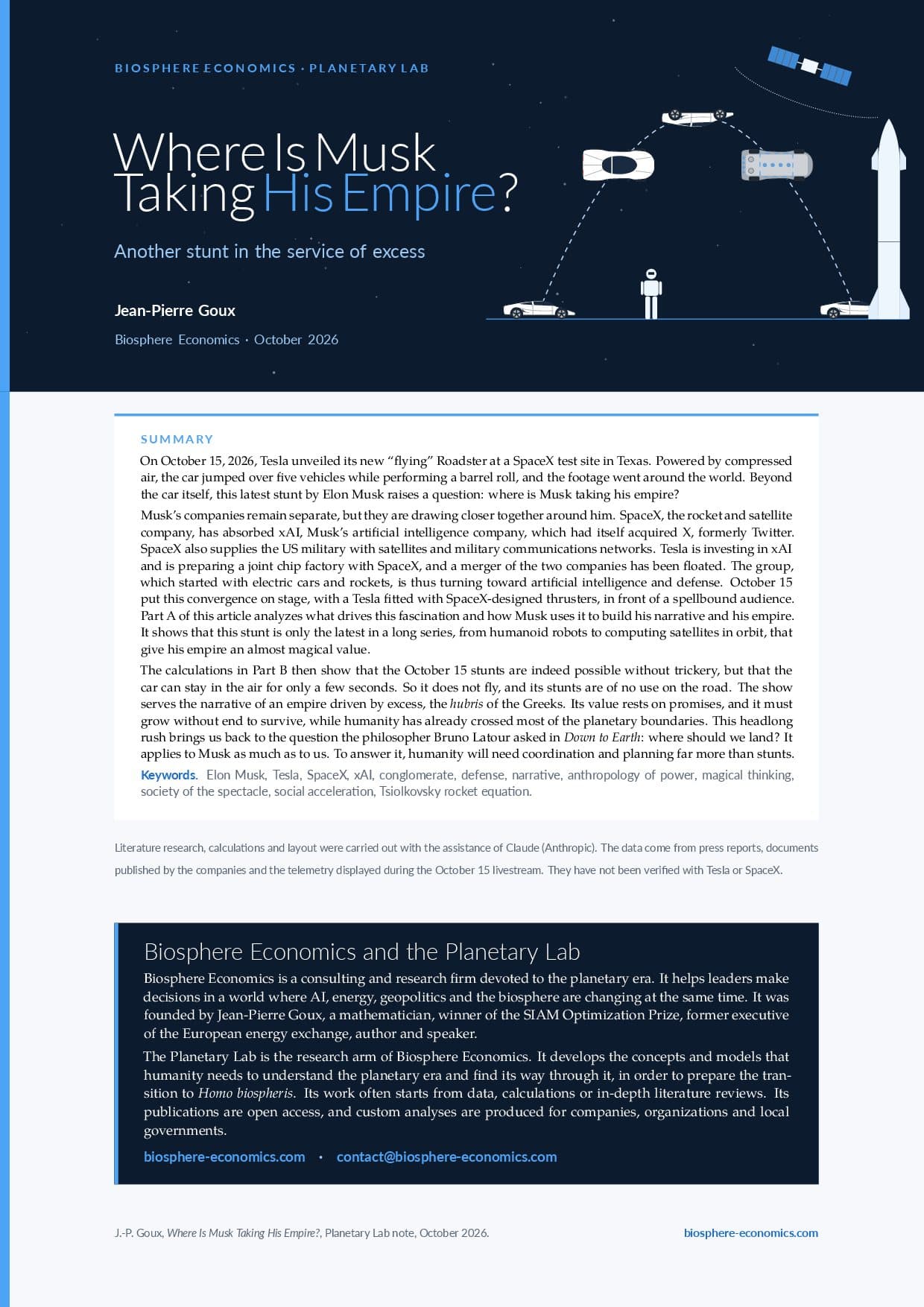
On October 15, 2026, Tesla unveiled its new “flying” Roadster at a SpaceX test site in Texas. Powered by compressed air, the car jumped over five vehicles while performing a barrel roll, and the footage went around the world. This latest stunt by Elon Musk, one of the figures shaping the planetary age, raises a question: where is he taking his empire?
Musk's companies remain separate, but they are drawing closer together around him. SpaceX absorbed xAI, which had bought X, then went public in the largest IPO in history. The group, which started with electric cars and rockets, is turning toward artificial intelligence and defense. Part A of the note analyzes this direction and the fascination Musk draws on. Part B checks with physics what the car can really do.
Key points
A demonstration of power
On October 15, Musk staged his power and the coming together of Tesla and SpaceX, at a SpaceX site, with thrusters designed by SpaceX. The car is not street-legal and heralds no product.
An almost magical valuation
The stock market values Tesla at about $850,000 per car sold, forty times a Toyota, while its sales are falling. Between 87 and 97% of its value rests on businesses that do not yet exist at scale.
Promises running late
The Roadster, self-driving, robotaxis, Optimus and Mars: Musk's promises are generally kept about twice as late as announced, and each missed one is replaced by a larger one. His tenacity has still made some of them come true.
Computing in orbit, the new frontier
The ambition went from 100 gigawatts to 100 terawatts in a few months. It carried the largest IPO in history, whose prospectus admits relying on “technologies that do not exist.” A terawatt a year would take tens of thousands of Starship launches.
A turn toward defense
Musk, who in 2017 warned against autonomous weapons, now co-leads a Pentagon mission on future warfare, while SpaceX and xAI sell to the military and the Golden Dome missile shield opens a new market.
Toward a single company
SpaceX has already absorbed xAI and X, and several signs point to all of Musk's companies coming together, Tesla included, extending the promises by backing the most fragile businesses with those that make money.
Room for uncertainty
This assessment may be proved wrong. Musk tipped the car industry toward electric and revolutionized space transport with reusable rockets, and Starlink could become an essential service. But in October 2026, Ukraine saw its drones lose their Starshield link without knowing who decided it: an essential service in the hands of a single man raises a question of governance.
Real stunts with no use
The physics shows that no fakery is needed: 250 kg of compressed air is enough for a 1.9-tonne car. But a single stunt uses up to 86% of the air supply, and the car stays airborne for only a few seconds.
This empire must grow to hold together, while seven of the nine planetary boundaries have already been crossed. The Greeks called this excess hubris. The question the philosopher Bruno Latour asked, where should we land?, applies to Musk as much as to us. To answer it, humanity will need coordination and planning far more than stunts.
Summary video · Part B (physics of the jump)
1 min 46 s
Simulator: the cost of a jump
Pick an obstacle, from a child to the Starship rocket, and see whether the Roadster’s 250 kg of compressed air is enough to clear it. The simulator uses the physical model from Part B of the note.
The code reproduces every value and chart in Part B. Each equation is explained and points to its section of the note. It requires Python 3.9 or later and the CoolProp library, and it is released under the MIT license.
Documents
Download the report
Sources
Selected references
- Tesla Oracle, Tesla stuns the world with the flying Roadster stunts, 15 October 2026.
- The AGI Clock, The physics of Tesla’s Roadster flip, 16 October 2026.
- InsideEVs, Here are all of the crazy tricks the Tesla Roadster just did, October 2026.
- Electrek, An updated technical look at Tesla’s kick-flipping Roadster, 15 October 2026.
- Bloomberg, Tesla Launches Roadster at SpaceX Site in Latest Merger Hint, 15 October 2026.