The most read work of fiction in the world
The myth humanity gave itself without knowing it
Distribution
The material condition of a planetary myth
A myth cannot be decreed from the top of an institution. It installs itself slowly in the memory of a civilization, until its name no longer needs to be explained. The Little Prince has accomplished this installation at a scale no other book has reached.
April 6, 1943, New York
First edition simultaneously in French and English at Reynal & Hitchcock. Saint-Exupéry has been in exile in the United States since the 1940 armistice. He is 43 years old. One week after publication, he leaves for the Free French Forces in Algeria. He will never see his book in a bookstore again. He disappears at sea on July 31, 1944.
More than 600 languages
From French to Aragonese, Tibetan to Luxembourgish, Malagasy to Gascon. The number grows every year. No other work of fiction comes close to this distribution.
Second most translated book after the Bible
A founding religious text on one side, a secular tale on the other. No other book holds this position in the history of human writing.
No system has rejected it
The Little Prince circulates in democracies and dictatorships alike, in theocracies and atheist regimes. No power has seen it as a threat. This free circulation over eighty years is what makes it possible to use the book as a myth shared by all of humanity.
Reading
Eighty years of circulation without a stable interpretation
Saint-Exupéry never commented on The Little Prince. He left for the war a few days after publication and never returned. From this silence, all interpretations were born: autobiography, mourning of childhood, spiritual parable. None gained authority.
Yet one fact recurs in almost all reader testimonies, across generations and languages: the book leaves an intimate imprint that readers cannot quite articulate. Many say it redirected their life at a precise moment. This is the signature of myths in circulation: they operate in the psyche before reason understands what they say.
The secret of the cover
The Little Prince is us
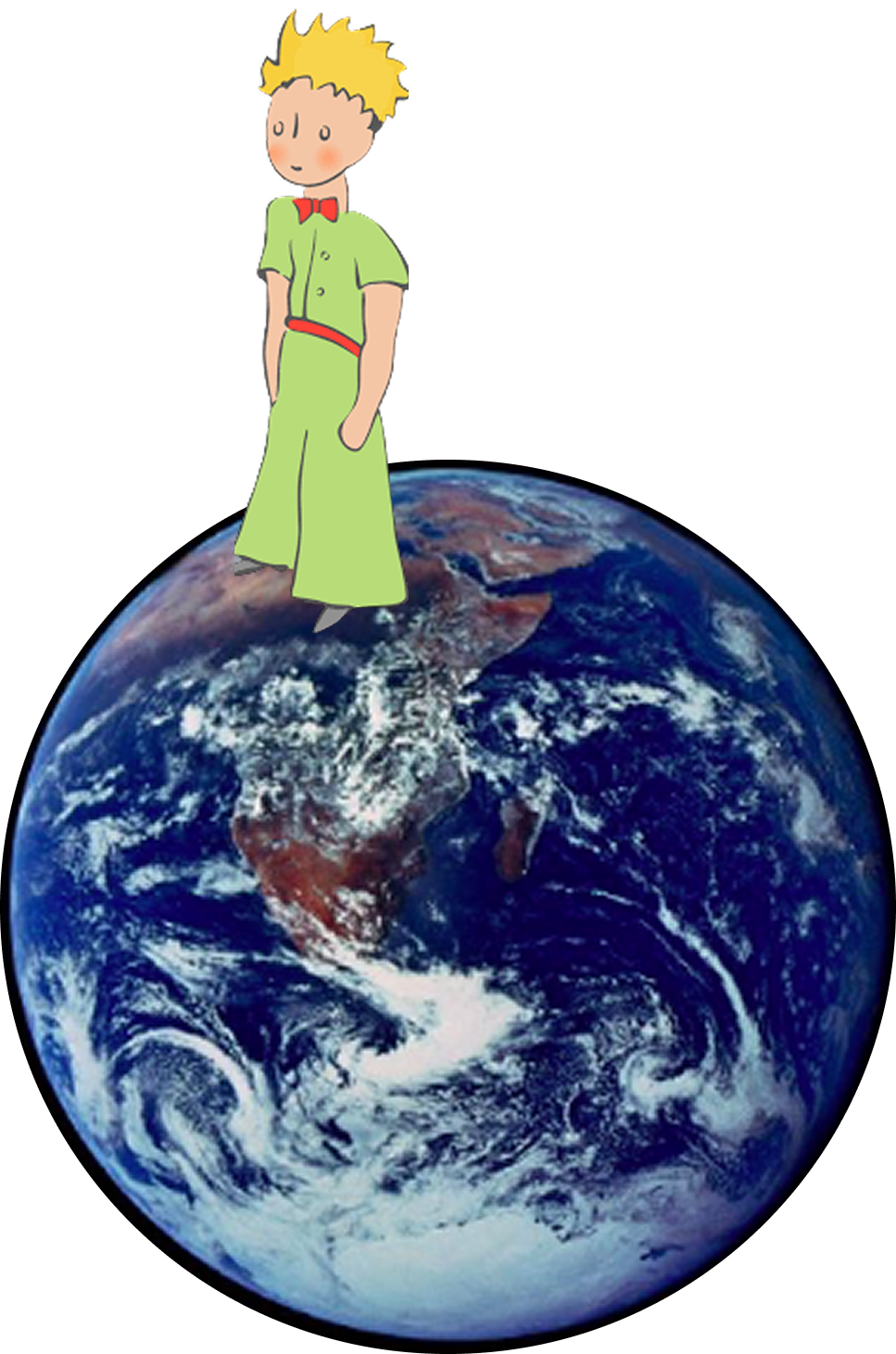
On the cover of the book, since 1943, a tiny being stands on a small planet. He is alone. No parents, no friends, no descendants. No other human lives on his planet, or in the story. Eighty years of readers, and the question has never been asked: why is he alone?
Because the Little Prince is not an individual. He is the humanity of his planet, gathered into a single self-aware figure, standing on the world it inhabits and cares for. The Little Prince is a fulfilled planetary collective.

Original edition · Reynal & Hitchcock · New York · 1943
Saint-Exupéry had warned us. "One sees clearly only with the heart. What is essential is invisible to the eyes." The most quoted sentence in the book is also its instruction manual. We have read it a thousand times without understanding it.
Saint-Exupéry's greatest secret was right before our eyes, on the cover of the most read book in the world after the Bible. We looked at it for eighty years without seeing it, because it was not visible with the eyes.
This reading was first formulated by Jean-Pierre Goux, developed in the Blue Revolution saga. It elevates The Little Prince from the status of a literary phenomenon to that of the founding myth of Homo biospheris.
The Little Prince is Homo biospheris.
Re-reading
Five essential gestures of a healthy planetary collective
Once it is accepted that the Little Prince is the humanity of his planet, each motif in the tale describes a gesture this humanity performs toward its world.
The baobabs
"One must regularly pull up the baobabs as soon as they can be distinguished from the rose bushes."
On the Little Prince's planet, baobabs grow silently and end up splitting the planet apart if not pulled up from the start. Saint-Exupéry sees in this the central threat, at the scale of the planet itself. The Little Prince teaches early vigilance and the regulation of what proliferates without limit.
Feet on the ground, head in the stars
The Little Prince knows every centimeter of his planet. He knows his three volcanoes, his two sunsets a day, his rose. He also dreams of the stars and eventually travels. This dual posture, rooted yet turned toward the Cosmos, is the right posture of Homo biospheris. Missions 9 and 10 (Explore the Cosmos, Protect against space dangers) are already inscribed in the tale.
The morning grooming
"When one has finished one's morning grooming, one must carefully groom the planet."
This instruction describes the daily life of Homo biospheris. It establishes two inseparable forms of care: care for oneself and care for the world. One does not go without the other. One cannot care for the Biosphere without first caring for one's own bonds.
Taming
"You become responsible, forever, for what you have tamed."
Taming in the tale is the opposite of possessing. It means creating a bond that commits. The rose does not belong to the Little Prince. He belongs to the rose, because he has cared for her. This is the anthropological shift at the heart of Homo biospheris: moving from "it belongs to me" to "I belong to it."
One sees clearly only with the heart
"One sees clearly only with the heart. What is essential is invisible to the eyes."
The book's most famous sentence states a very precise perceptual rule. Humans see things, but do not see the links between things. Yet links are not visible with the eyes. They are felt. For Homo biospheris to form, billions of humans must learn to perceive the bonds between each other and with the living world.
Diagnosis
Six solitary giants, six pathologies of the planetary collective
Before arriving on Earth, the Little Prince visits six planets. Each is inhabited by a single human, giant and solitary. Saint-Exupéry sketched a typology: six ways a planetary collective can fall ill. Today's humanity presents all six pathologies simultaneously.

The King
The King rules over everything, including the sunset. He believes his planet belongs to him. The pathology of a humanity that thinks it owns the Earth, while it belongs to it.

The Vain Man
The Vain Man perceives only applause. The pathology of a collective that measures its value by visibility and dies of thirst in the middle of its own streams of attention.

The Drunkard
The Drunkard drinks to forget that he is ashamed of drinking. An addiction loop with no exit. The pathology of a collective imprisoned by its dependencies, all born of the same lack of love.

The Businessman
The Businessman counts the stars he thinks he owns, without ever looking at them. The pathology of a humanity that looks at the world through its spreadsheets and loses touch with reality.

The Lamplighter
The Lamplighter faithfully follows an instruction that has become absurd. The instruction has had no meaning for a long time, but no one questions it. The pathology of a humanity that wakes up each morning without having formulated its evolutionary project.

The Geographer
The Geographer draws maps of the world without ever leaving his desk. The pathology of a humanity that looks at the Biosphere from its screens, maps without seeing, and deprives itself of the miracle of being alive.
The Little Prince has overcome these six pathologies on his asteroid B 612. That is why he comes to Earth. He is proof that a way out exists.
The heart of the tale
A human consciousness in dialogue with a planetary consciousness
The pilot has crashed in the middle of the Sahara. He has six days of water. He is going to die. It is in this state of reprieve that he meets the Little Prince, who appears one morning from nowhere and disappears at the end without anyone knowing where.
This structure ceases to be strange once one understands what the Little Prince is. The pilot is individual-humanity, isolated by his breakdown, about to die. The Little Prince is the planetary consciousness this humanity encounters, for the time of a dream, in the void of the desert.
This is the position of Homo sapiens in the planetary age. On borrowed time in a desert of its own making, it encounters the embryo of its own planetary soul, not knowing whether it will be able to grow.
Corroboration
Saint-Exupéry, two months before his death, states in plain language what the tale says in images
Saint-Exupéry never commented on The Little Prince. But on May 29, 1944, two months before his disappearance, he wrote a letter in the United States, prompted by a conversation with a young American pilot. Read alongside the book, this letter states the diagnosis of which The Little Prince may be the answer: the soul of a collective humanity in emergence.
"You see, my American friends, it seems to me that something new is taking shape on our planet. The material progress of modern times has indeed linked men through a kind of true nervous system. The connections are innumerable. Communications are instantaneous. We are materially united like the cells of a single body. But this body does not yet have a soul. This organism has not yet become conscious of itself. The hand does not know it is bound to the eye."
Antoine de Saint-Exupéry · Letter to an American · May 29, 1944
The stake of the century
Which narrative will inhabit the unified planetary body?
Four narratives are competing to inhabit this body. Each carries a figure of soul and produces a particular type of planetary collective. Three lead to sick humanities.
United States
Planetary capitalism
Figure: The billionaire entrepreneur who pushes boundaries with no project for the Earth.
Collective: Eight billion competing individuals, whose horizon does not extend beyond the quarter.
China
Civilization-state
Figure: The sovereign to whom the planet belongs, guarantor of order through force and duration.
Collective: Eight billion administered subjects, whose diversity is subordinated to stability.
Transnational AI actors
Techno-feudalism
Figure: The calculating intelligence that optimizes without belonging, decides without loving, structures without caring.
Collective: Eight billion humans dependent on infrastructures whose keys and meaning they do not hold.
All of humanity
Homo biospheris · Blue Revolution
Figure: The Little Prince: standing on his planet, caring for it each morning, taming rather than possessing, seeing with the heart, dreaming of the stars without ceasing to be rooted.
Collective: Eight billion upright, conscious humans, in relationship with the Biosphere and the Cosmos, whose diversity is the condition of unity.
The planetary body exists. The soul is forming. Three soul-figures impose themselves through power, order, or calculation. Only one offers itself through care.
See also: Four Competing Narratives · Ch. 02
Recognition
The Saint-Exupéry Estate has committed alongside the Blue Revolution

Jean-Pierre Goux and Olivier d'Agay
Olivier d'Agay, great-nephew of Antoine de Saint-Exupéry and guardian of his work since 2005, recognized this interpretation as consistent with his great-uncle's thinking. He wrote the preface to the novel La Petite Princesse (Eyrolles, 2024), the first volume of the Blue Revolution saga in which the interpretation is developed.
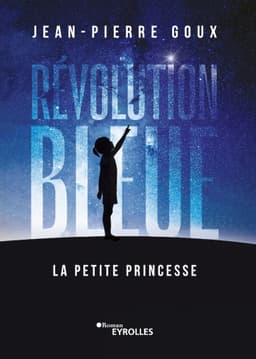
Eyrolles, 2024
First volume of the Blue Revolution saga. The Homo biospheris interpretation is developed there in novelistic form.
Synthesis
Humanity was searching for its new myth. It already had it.
Every civilization has been carried by a myth. Humanity in the twenty-first century has entered the planetary age without a new one, with inherited myths that no longer know how to name what it has become. Yet since 1943, a narrative has circulated across all cultures, in more than 600 languages, under the guise of a children's book. This narrative has been read, loved, and passed on, without ever being identified for what it is. The Little Prince is the portrait of a conscious planetary collective: it humbly inhabits its planet, pulls up the baobabs, grooms the world, tames rather than possesses, dreams of the stars without ceasing to be rooted, sees with the heart. Thinking collectively like a Little Prince is exactly what Homo biospheris requires. The narrative exists. It is everywhere. It has been recognized by the guardians of the book. All humanity needs to do now is recognize itself in it.
A production of the Planetary Lab
© 2026 Biosphere Economics · CC BY-NC-ND 4.0
Into action
The Little Prince is the myth humanity was waiting for. These two formats help your organization recognize itself in this narrative and draw a strategic compass from it.
Keynote conference
The Blue Revolution
A galvanizing story for transition at a global scale. To anchor change in your organization.
30 to 90 min · executive committees, corporate events
Strategic seminar
Navigating the Planetary Age
Toward the planetary-robust enterprise. A seminar that builds on this diagnosis to equip your organization.
1 to 2 days · executive teams, leadership committees